
How to Reduce Bending at Home: Fix Heights, Not Habits
The most effective way to bend less at home is to change the height of the things you use every day, so your body no longer has to meet them halfway. A bed you lower yourself onto, a sofa you sink into, a desk that makes you hunch: each one asks for a small bend, dozens of times a week. Raise the furniture, move everyday items to waist level, and the bending mostly stops. We build custom 3D-printed furniture risers to the exact measurements you give us, so the height of each piece can be set to fit you rather than the other way around.
TL;DR
- Most of the bending in a home comes from a few fixed-height items: bed, sofa, chairs, desk, low cabinets. Fix those first.
- Clinical guidance from UW Orthopaedic Surgery and others says work surfaces should sit at a height where your elbows are at right angles and your shoulders are relaxed.
- Keep what you use daily between waist and shoulder height, and heavy things at waist level.
- Use reachers and stools for the leftovers, and break long bending jobs into shorter bouts.
- Custom risers let you set furniture height to the hundredth of an inch, with round, angled or irregular legs supported.
Table of Contents
- Where the bending really comes from
- The principle: use the strongest joints and keep surfaces at your level
- Raise the furniture, not just the habits
- Raise safely: what to check before you lift
- Bring everyday items up to waist level
- Laundry, cleaning and floor-level jobs
- Keep moving while you remove the strain
- Why custom heights beat guessing
- Ready to raise the first piece
- FAQ
- Sources
Where the bending really comes from
Before buying or moving anything, spend one ordinary day noticing every time you fold at the waist. Most people find the same short list:
- Sitting down into and standing up from a low sofa or chair.
- Sitting on and getting off the edge of a low bed, or making it.
- Leaning over a desk or table that is too low.
- Loading and unloading the washer and dryer.
- Reaching into low cabinets and the bottom of the pantry.
- Picking things up off the floor.
The CDC’s NIOSH guidance for home caregivers lists the same family of movements to avoid: reaching, bending, stretching and twisting. Its fixes are practical: long-handled tools, a step stool, heavy items kept at waist height, big loads split into small ones, and a cart for carrying. The principle is simple. Change the setup once, and you stop paying for it with your back every day.
The principle: use the strongest joints and keep surfaces at your level
UW Orthopaedic Surgery and Sports Medicine describes joint protection this way: use the strongest joints and muscles whenever possible, and spread the load across larger joints or the whole body. It also advises that whether you sit or stand, work surfaces should be at a height that keeps your elbows at right angles and your shoulders relaxed. When you do have to lift something low, bend your knees, keep your back straight and lift by straightening your legs.
It also suggests treating pain as a signal: if a task leaves you hurting for more than two hours afterward, plan to do it differently next time. That is a good test for any change you make at home. If you still feel a task the next day, the height is probably still wrong.
If you have back or joint pain, a physical therapist or your doctor is the right person to set your exact positions and limits. What follows is general ergonomics, not a treatment plan.
Raise the furniture, not just the habits
Tips like “squat properly” ask you to do something right every single time. A height change works without you thinking about it. This is where custom risers do the most for the least effort.
Sofas and chairs: make standing up easier
A low seat forces you to fold deeply at the hips and knees, then push up through the whole movement. Arthritis Australia points out that a higher chair makes getting up much easier because you are already almost half-way up, and recommends choosing the highest chair that still lets your bare feet rest flat on the floor while seated.

That last condition matters, and it is why one-size-fits-all lifts often miss. The right lift depends on your leg length, the seat cushion and the frame. With couch and sofa risers made to the measurement you enter, you can set the lift to the inch you need. Our guide to couch risers for seniors walks through how to pick that height for a low sofa. For dining and accent chairs, chair risers work the same way, and our piece on chair risers for tall people covers fitting a chair to a taller frame without replacing it.
Beds: less of a drop, less of a push
A bed that sits too low turns every morning into a deep-knee push. Raising it brings the mattress closer to your standing height. It also frees the space underneath for storage, which helps if you live in an apartment and would otherwise be bending to a closet floor. Our guide to how much lift you really need under a bed covers the trade-offs, and bed risers can be made for round, angled or irregular legs as well as standard ones.
Desks and tables: elbows, not shoulders
A desk that is too low makes you lean forward and hunch. FIRA’s home office buying guide says a work surface should be in line with or slightly lower than elbow height. It gives 720 to 760 mm (about 28.3 to 29.9 inches) as the range for fixed-height desks, and notes that a desk that is too low can strain your arms, shoulders and back. If you are tall, your elbows may sit well above that range.
To check your own setup, sit with your feet flat and your upper arms hanging relaxed, then bend your elbows to a right angle. Your forearms should rest level with the desk surface. If the desk is lower, measure the gap and that is the lift you need. Desk risers and table risers can be made to that exact figure. Our home office ergonomics guide covers the rest of the chair and desk setup.
Worked example: a low sofa and a low desk
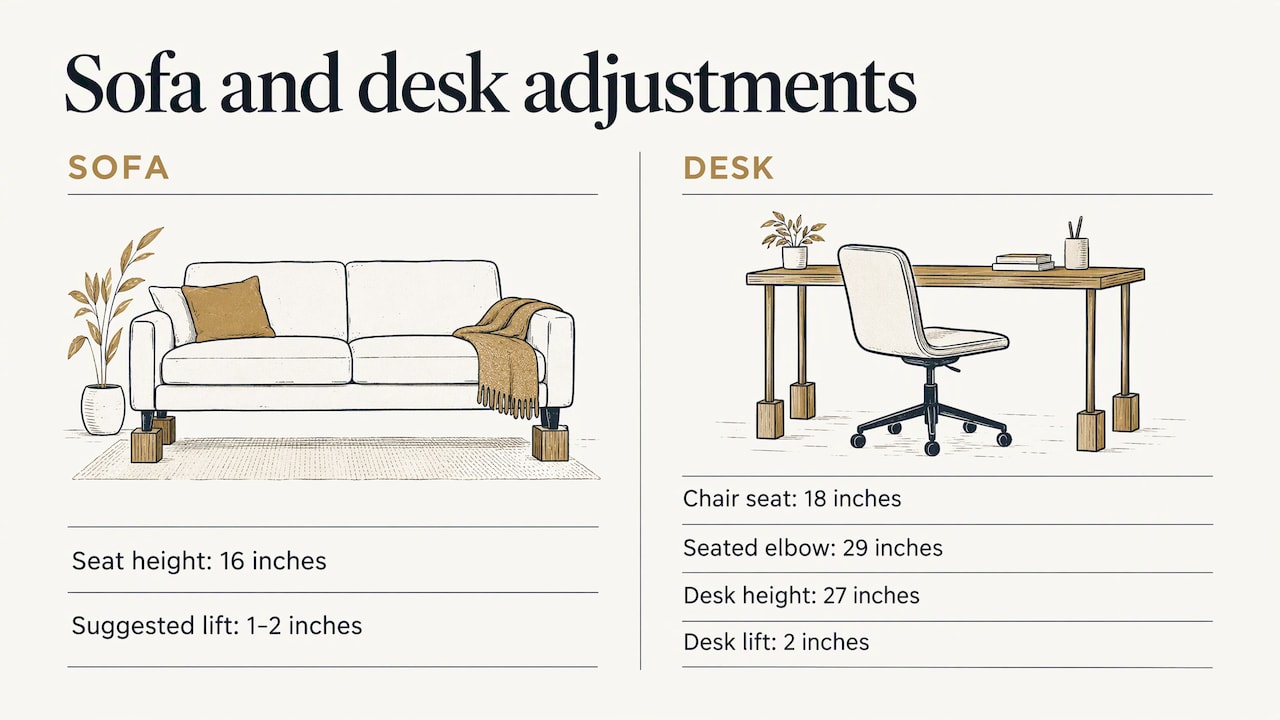
Say you stand 6 feet tall, your sofa seat is 16 inches from the floor and your knees sit well above your hips when you sit. A lift of one to two inches might be all it takes to make standing up smoother, and you can measure it by trying the seat height of a chair that feels comfortable and subtracting. Now the desk: your relaxed elbow height seated is 11 inches above the seat of your chair, which sits at 18 inches, so your elbow is at 29 inches. A desk at 27 inches is two inches too low. Two inches of lift fixes it with no change in how you work. The numbers are yours, not ours, which is the point of ordering to your own measurements.
Raise safely: what to check before you lift
Any lift changes how furniture carries weight, so treat stability as part of the job. These checks keep a raised piece safe in daily use:
- Know the load. Add up the furniture and what it carries: a bed with two adults, a desk with monitors and equipment. For heavy loads, order heavy-duty risers. Our risers have an extra stability option for heavier uses, priced at $5.00 each, one time.
- Match the riser to the leg. Round, tapered or angled legs need a riser built for that shape, not a flat cup that happens to nearly fit. We make risers to the leg dimensions you enter.
- Check that every leg is lifted by the same amount and the piece sits level and does not rock.
- Move heavy items carefully. Our step-by-step guide on how to raise heavy furniture safely covers lifting and placing.
- Retest after a week. Push on the piece from the side. If it shifts or wobbles, fix it before regular use.
If you are lifting a medical bed, a bed with a powered base or anything a caregiver or clinician specified, check the manufacturer’s weight and height limits first.
Bring everyday items up to waist level
Furniture is half of it. The other half is what you reach for. Several sources agree on the same zones.
The National Institute on Aging recommends keeping pots, pans and utensils you use often where they are easy to reach, at waist level or within easy reach, and preparing food while seated to prevent fatigue or loss of balance. The NHS pain management household tasks sheet from the Queen Elizabeth Hospital King’s Lynn adds that heavy appliances belong at waist level, and that you can slide heavy objects along worktops instead of lifting them.
A simple way to apply that:
| Zone | What goes there |
|---|---|
| Waist to shoulder | Everything you use daily: plates, mugs, coffee, medicines, toiletries |
| Just above or below | Weekly or occasional items |
| Top shelf and floor of deep cabinets | Seasonal or rarely used things |
| Lower shelves | Heavy items you rarely lift, kept close to the front |
The zones follow a common aging-in-place layout described by Shelf Proz, and the principle is easy to adapt to a rental kitchen with no remodel.
If you live in a small space, going up in height also means going up in storage. Raising furniture to reclaim the floor beneath it gives you a place for the things you would otherwise stash low. See our ideas for multifunctional furniture in small rooms and adding storage under a sofa.
Laundry, cleaning and floor-level jobs
Some tasks stay low whatever you do to the furniture. For those, change the posture, not the task.
- Laundry. The NHS sheet advises kneeling or sitting on a stool to load and unload the washer and dryer, keeping the basket on a small box or stool, and doing more small loads instead of a few heavy ones.
- Repeated forward bending. Physical therapist Chelsea Barron, DPT, recommends a half-kneeling position for jobs such as cleaning the tub or taking laundry out of the dryer, switching knees from time to time.
- Ironing or folding. Keeping one foot on a small step stool changes your pelvis and low-back position. For ironing, the NHS sheet suggests a perching stool and a board set low enough that you do not raise your shoulders.
- Cleaning. Gillette Children’s guidance says to avoid twisting and bending at the waist while cleaning or moving large items, and to use extended handles.
- Things on the floor. UW recommends reachers instead of bending to get things from the floor or low cupboards.
The Arthritis UK equipment guide has other small ideas: a basket inside the letterbox, a laundry basket with a handle and wheels, and raising the washing-up bowl on blocks.
One safety point from the NIA: never stand on a chair or table to reach something high. Use a reach stick, or a steady step stool with a handrail on top and someone standing next to you.
Keep moving while you remove the strain
Bending less does not mean moving less. Texas Health’s guidance says that although the first instinct in pain is to stop everything, the better strategy is staying active within your tolerance and splitting repetitive bending jobs into shorter bouts that end before fatigue. Singapore General Hospital’s physiotherapists suggest taking a break every 20 to 30 minutes to stretch and change posture. Arthritis UK adds that you should keep exercising your joints in other ways when equipment takes over a task, and it recommends an occupational therapist for equipment advice and pacing.
So set the furniture heights once, then build short stretch breaks into your day.
Why custom heights beat guessing
Standard risers come in preset sizes and can miss on both height and fit. Furniture legs are round, angled, tapered, square or irregular, and a good ergonomic height is usually between two preset steps. Because the whole point is a height that matches your body, a one-inch miss can undo the benefit.
With a RiserMan order, you enter your dimensions down to the hundredth of an inch, and the configurator updates the cost as you pick options. Wood grain texture is $5.00 each, one time, and extra stability is $5.00 each, one time. You can also choose from colored or metallic finishes to match the room, and furniture legs are available if you would rather replace the legs entirely. For interior decorators, that means specifying a height for a client’s sofa or desk instead of working around a catalog.
Our view: height is the cheapest ergonomic upgrade
We started from a simple observation: furniture is built to average heights, and nobody is average in every room. A sofa that suits one person leaves another pushing up from a deep seat. A desk that fits one person leaves a taller one hunched.
That is why we build risers to your measurements rather than a catalog size. Round legs, angled legs and irregular legs are supported, and heavy-duty reinforcement is there for beds, sofas and desks that carry real weight. The lift can also open up hidden storage underneath, which matters when every square foot counts.
The best ergonomic change is the one you never have to remember. Raise the seat once and you stop bending every time you sit down.
Harris
Ready to raise the first piece
Start with the one you bend toward most: the sofa you struggle to stand up from, the desk that makes your shoulders creep up, or the bed you drop onto. Measure the height you want, then enter it in the configurator at RiserMan and watch the price update as you add finishes or extra stability. Each product page, from bed risers to desk risers, takes the same measurement-first approach.

FAQ
Should you bend at your knees or waist?
Bend at your knees and hips when you have to lift something low. UW Orthopaedic Surgery advises bending your knees, keeping your back straight and lifting by straightening your legs. For repeated low tasks, a stool or a half-kneeling position reduces how often you need to do it at all.
What is the fastest way to bend less at home?
Raise the items you use most. A sofa, bed or desk at the right height removes bending several times a day. After that, move daily items to between waist and shoulder height and use a reacher for anything left on the floor.
What height should a desk be?
FIRA advises that a work surface should be in line with or slightly lower than your elbow height. Fixed desks are usually 720 to 760 mm (about 28.3 to 29.9 inches), so taller people often need a lift. Measure your seated elbow height and raise the desk to match.
How high should a sofa or chair be to make standing easier?
Arthritis Australia recommends the highest seat that still lets your bare feet rest flat on the floor while sitting. A higher seat means you start almost half-way up. Custom risers let you land on that exact height.
How often should I take breaks from bending tasks?
Singapore General Hospital suggests a break every 20 to 30 minutes to stretch and change posture. Texas Health’s physical therapist advises stopping repetitive bending jobs before fatigue sets in. If you have back or joint pain, ask your doctor or physical therapist for limits that fit you.
Sources
- Ergonomics in the Home, Gillette Children’s
- Household tasks sheet, Queen Elizabeth Hospital King’s Lynn NHS Pain Clinic
- Caring for Yourself While Caring for Others, Module 2, CDC/NIOSH
- Good posture during daily activities, Singapore General Hospital
- Using Joints Wisely, UW Orthopaedic Surgery and Sports Medicine
- Tips for Completing Everyday Tasks with Back Pain, Texas Health
- Gadgets and equipment for your home, Arthritis UK
- Preventing Falls at Home: Room by Room, National Institute on Aging
- Your home, Arthritis Australia RA support program
- Home Office Buying Guide, FIRA
- How to Organize Cabinets for Aging in Place, Shelf Proz