
Dining chair risers & leg extenders
Chair Risers for Dining Chairs, Made for Your Chair's Legs
A chair is a small footprint carrying a moving person, so the fit of the opening matters more here than anywhere else. With a modest lift, correctly sized openings and angled cuts where the legs splay, risers turn a chair that is too low into one that matches the person and the table.

Cut to your measurement, to two decimal places.
Made to order · ships in 3–5 business days.
Indoor use only, keep out of direct sunlight and extreme temperatures.
Details
Measuring chair legs, including angled ones
Turn the chair upside down on a table. Dining chair legs are usually square or round at the floor, and very often they splay outwards, which means the cut end sits at an angle rather than flat. Measure the widest dimension of the leg at the point where it will enter the riser, then add a quarter inch of clearance to each dimension.
For splayed legs, add a note in the notes box saying the legs are angled and roughly how far out they lean, so the opening can be cut at a matching angle and the whole cut face of the leg beds down inside the riser. This matters more on a chair than anywhere else: if an angled leg rests on one edge of a flat opening, the contact point is tiny and the chair will rock.
Front and back legs are often different. On many dining chairs the back legs are thinner and angled, while the front pair are straight and slightly thicker. Measure both pairs and, if they differ, add two lines to the cart, two risers of each size, rather than forcing one size to cover both.
How much to raise a chair, and when not to
The gap between the seat and the underside of the table is what makes a dining set comfortable. Measure that gap now, and if you have raised your table, raise the chairs by the same amount to keep it. A lift of one to three inches is the usual choice, and past that the sitter's feet stop reaching the floor, which is less stable rather than more.
A wide base with a short lift is the steadiest combination on a chair. Office chairs on a five-star caster base are not suited to risers at all; use the chair's own gas cylinder adjustment. High stools, rocking chairs, recliners with moving mechanisms and folding chairs are also poor candidates, because their center of gravity already moves during use.
Whatever height you choose, put risers under every leg, keep all four on level flooring, and check them again after a week of use. A chair that gets dragged will work its legs loose in a way a bed never does.
Weight and dynamic load
A dining chair is light, so almost all the load is the person in it. That load is dynamic: sitting down drops a body weight onto two legs at once, and people lean back, tip onto rear legs, and shift sideways. A chair riser therefore sees a higher peak load per riser than a bed riser under the same total weight.
Enter the weight of the heaviest person likely to use the chair, plus the chair itself, in the configurator's weight field. The reinforced build is the sensible default on a chair riser used by an adult, and a raised chair should never be tipped or rocked. If a chair is used by children who climb, kneel or swing on it, risers are not the right answer.
Configurator
Build your chair risers
We've prefilled a typical size for this kind of furniture, change it to your own measurements, then enter the total weight the risers will carry.
1. Base size
Riser footprint, after clearanceChoose the one-inch range your riser should be, after adding clearance to the leg. If your leg is 1" × 1", pick a base range that includes at least 1.25" × 1.25".
2. Height
How far you're liftingChoose the one-inch range for the lift you want.
With a 1–2" base, heights above 6" are grayed out. A narrow footprint lifted that high gets tip-prone, step up a base size to unlock taller risers.
3. Exact dimensions
Dimensions of the riserDecimals welcome, enter your exact number. These are the dimensions of the riser itself, not the furniture leg. If your leg measures 1" × 1", add clearance and enter at least 1.25" × 1.25".
Sizing tip: Add at least 1/4" of clearance on every side of the leg so the riser fits easily and stays stable. A 1" × 1" leg should become a 1.25" × 1.25" (or larger) riser base.
Not sure how to measure? Tap for a quick guide
- Measure the bottom of the leg where it touches the floor, side to side (width) and front to back (depth).
- Add 1/4" to each number for clearance. A 2" leg becomes 2.25".
- For height, pick how much lift you want. Under 3" is the most popular for beds.
- Still unsure? Text a photo of the leg next to a ruler to 860-856-3633 and I'll tell you the size to order.
Starting size, enter your own measurements.
Opening size, including 0.25" clearance
Opening size, including 0.25" clearance
Within 2–3"
Rectangular leg? Choose the range for your longer opening dimension. The shorter side can be below that range, down to 0.5". Add 0.25"to each measured leg dimension before entering it.
Total weight: 200 lbs (typical chair or desk). Heavier? Change this.
Include the furniture plus anything (or anyone) on it, a bed frame, mattress and the people sleeping on it, for example. This helps us build safely.
4. Color
No extra costAll colors are the same price, pick the one that disappears into your furniture.
Wood tones
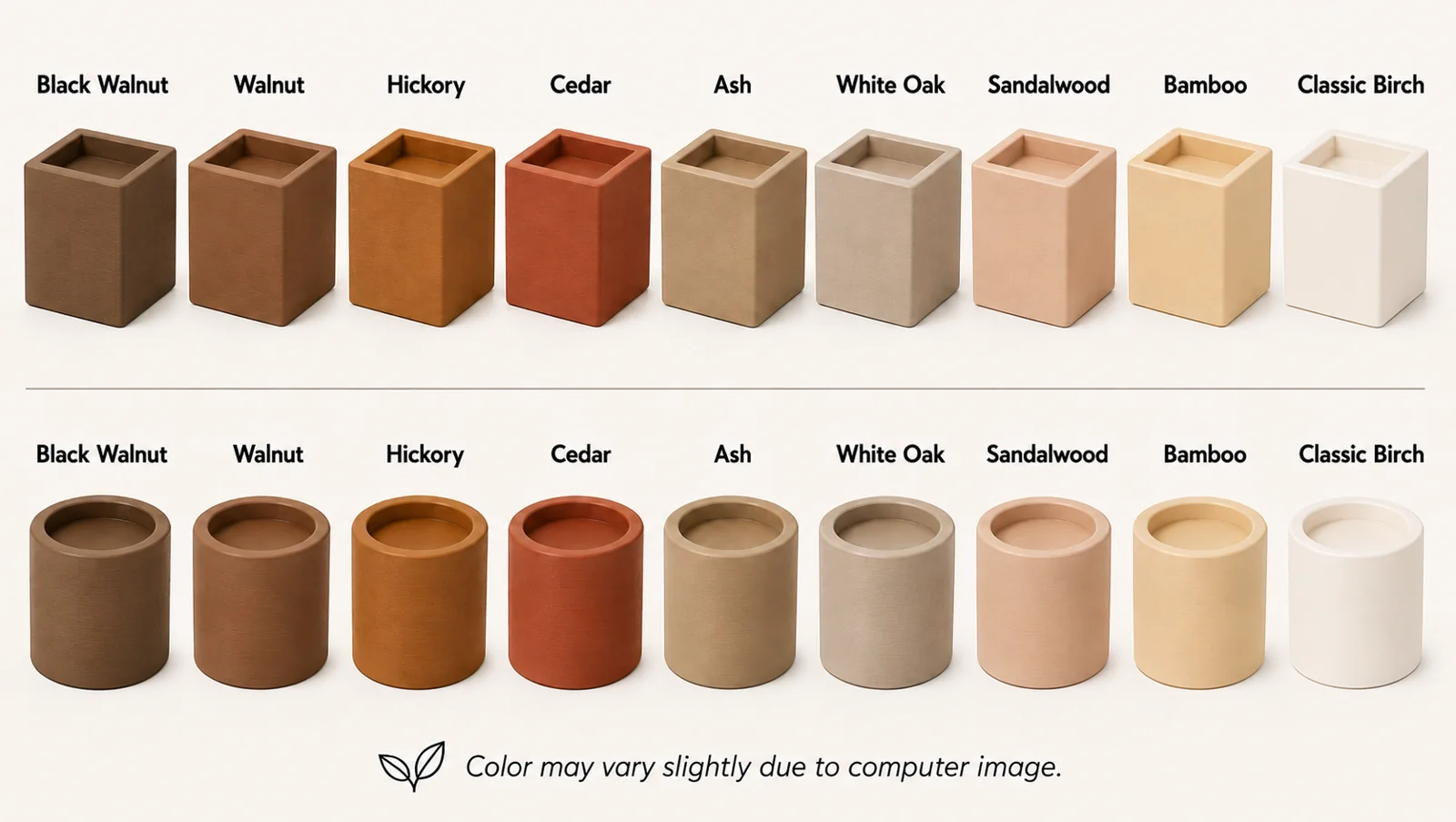

Customize more: wood grain texture, extra stabilityOptional · show
5. Custom shapes & notesOptional · show
Any shape is available: circles, ovals, L-shapes, triangles, tapered or angled legs. Choose the base range that covers the widest part of the leg, then add the shape and its dimensions in the notes below.
0/600 characters
FAQ
Chair risers questions
Yes. Chair leg extenders and chair risers do the same job: they slip over each leg and raise the seat. Ours are 3D printed to your chair's exact leg size, so they fit snugly on dining chairs with square, round or angled legs.