
For tables
Table Risers Cut to Your Table's Base
Tables get raised for three very different reasons: to reach counter height, to clear a chair arm or wheelchair, or to lift a coffee table to a usable height for eating and working. Each needs a different lift, and all of them need an opening cut to your actual leg, not a generic cup.
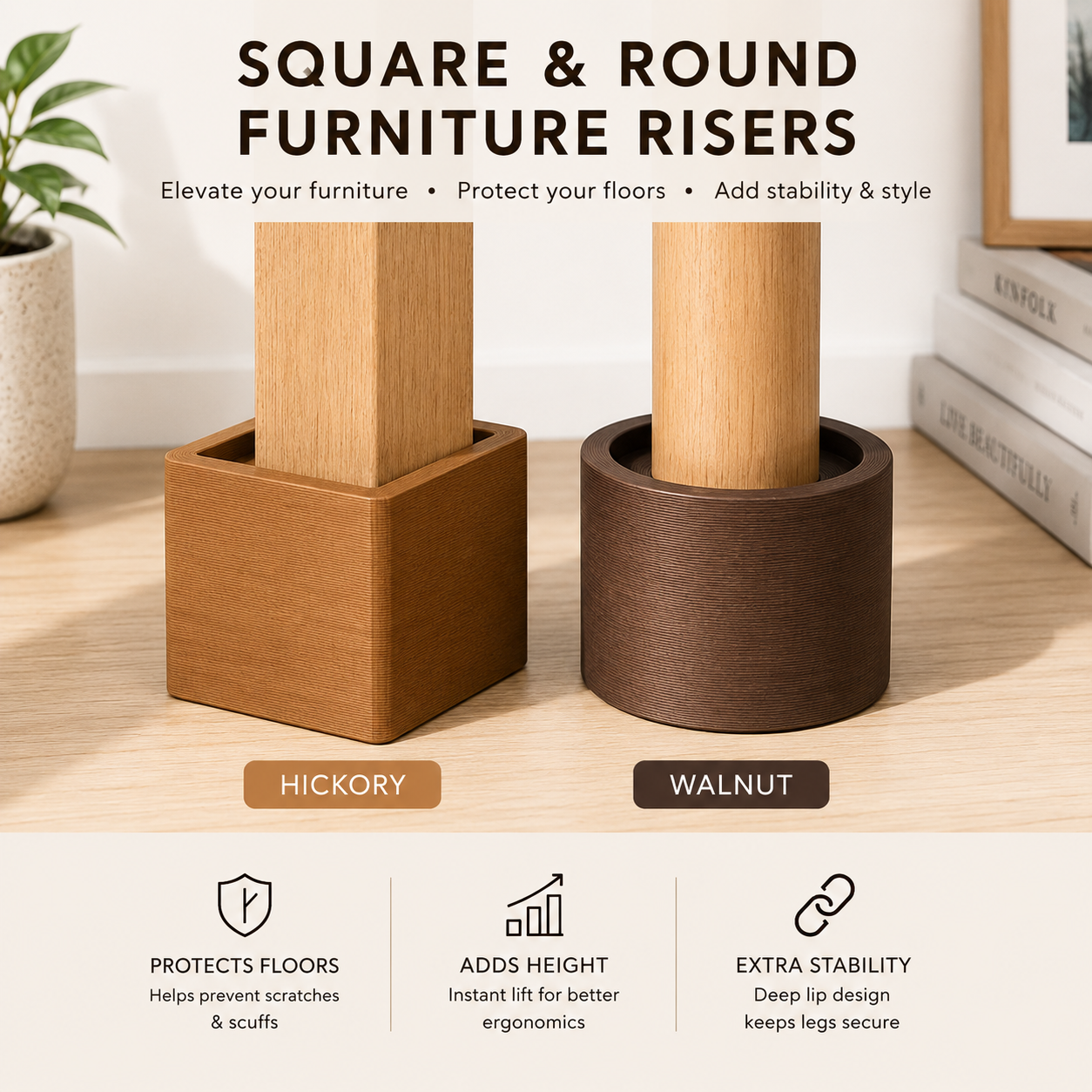
Cut to your measurement, to two decimal places.
Made to order · ships in 3–5 business days.
Indoor use only, keep out of direct sunlight and extreme temperatures.
Details
Measuring the different kinds of table base
Four-leg tables are straightforward: measure each leg's footprint at floor level at its widest, add a quarter inch to width and depth, and order four risers. Farmhouse and refectory tables often have thick square posts, which is good news for stability, since a wide base is the steadiest thing you can put a riser under.
Pedestal tables are different. A single central column usually ends in three or four splayed feet, or in a solid disc or cross base. Each foot needs its own riser, cut to that foot's shape, and a splayed foot needs an angled opening. A solid disc base has no discrete foot to capture, so a riser is generally not appropriate there. Text us a photo before ordering if you are unsure which you have.
Trestle tables sit on two long feet running across the table's width. Two risers per foot, placed near each end, suit those better than one long piece. Add the foot's width and thickness in the notes box. Whatever the base, measure the floor-to-underside height at each corner too: many older tables are already sitting unevenly, and lifting them multiplies the error.
Common table heights and lifts
Start from the height you want the tabletop to end up at, then subtract what you have now. Short adjustments are the normal use for table risers and preserve the table's original stance. Converting a dining table toward counter or bar height requires a much larger change and is not a recommended use under a loaded tabletop.
For a coffee table, decide what small change would make the surface more useful from your usual seat, then measure that difference rather than choosing a tall lift by category. Use the shortest lift that reaches the target, and favor a broad footprint whenever the table base allows it.
Clearance under the apron is the third case. Many tables have an apron that eats into the space under the tabletop, so measure to the underside of the apron rather than the tabletop, compare it to the clearance you need, and lift by the difference.
Load and how a tabletop spreads it
Table loads are heavy but static. Because a tabletop is rigid, the weight of the table plus everything set on it is distributed reasonably evenly across the legs, far more evenly than a bed or a sofa distributes its load.
The real risk on a table is not the vertical load but leaning. People push down on the edge to stand up, and children hang off the corner, which converts a static load into an off-center one on a single riser. Add the reinforced build for a heavy table, or any table people push against, and enter the loaded total in the configurator's weight field.
Configurator
Build your table risers
We've prefilled a typical size for this kind of furniture, change it to your own measurements, then enter the total weight the risers will carry.
1. Base size
Riser footprint, after clearanceChoose the one-inch range your riser should be, after adding clearance to the leg. If your leg is 1" × 1", pick a base range that includes at least 1.25" × 1.25".
2. Height
How far you're liftingChoose the one-inch range for the lift you want.
With a 3–4" base, heights above 8" are grayed out. A narrow footprint lifted that high gets tip-prone, step up a base size to unlock taller risers.
3. Exact dimensions
Dimensions of the riserDecimals welcome, enter your exact number. These are the dimensions of the riser itself, not the furniture leg. If your leg measures 1" × 1", add clearance and enter at least 1.25" × 1.25".
Sizing tip: Add at least 1/4" of clearance on every side of the leg so the riser fits easily and stays stable. A 1" × 1" leg should become a 1.25" × 1.25" (or larger) riser base.
Not sure how to measure? Tap for a quick guide
- Measure the bottom of the leg where it touches the floor, side to side (width) and front to back (depth).
- Add 1/4" to each number for clearance. A 2" leg becomes 2.25".
- For height, pick how much lift you want. Under 3" is the most popular for beds.
- Still unsure? Text a photo of the leg next to a ruler to 860-856-3633 and I'll tell you the size to order.
Starting size, enter your own measurements.
Opening size, including 0.25" clearance
Opening size, including 0.25" clearance
Within 2–3"
Rectangular leg? Choose the range for your longer opening dimension. The shorter side can be below that range, down to 0.5". Add 0.25"to each measured leg dimension before entering it.
Total weight: 200 lbs (typical chair or desk). Heavier? Change this.
Include the furniture plus anything (or anyone) on it, a bed frame, mattress and the people sleeping on it, for example. This helps us build safely.
4. Color
No extra costAll colors are the same price, pick the one that disappears into your furniture.
Wood tones
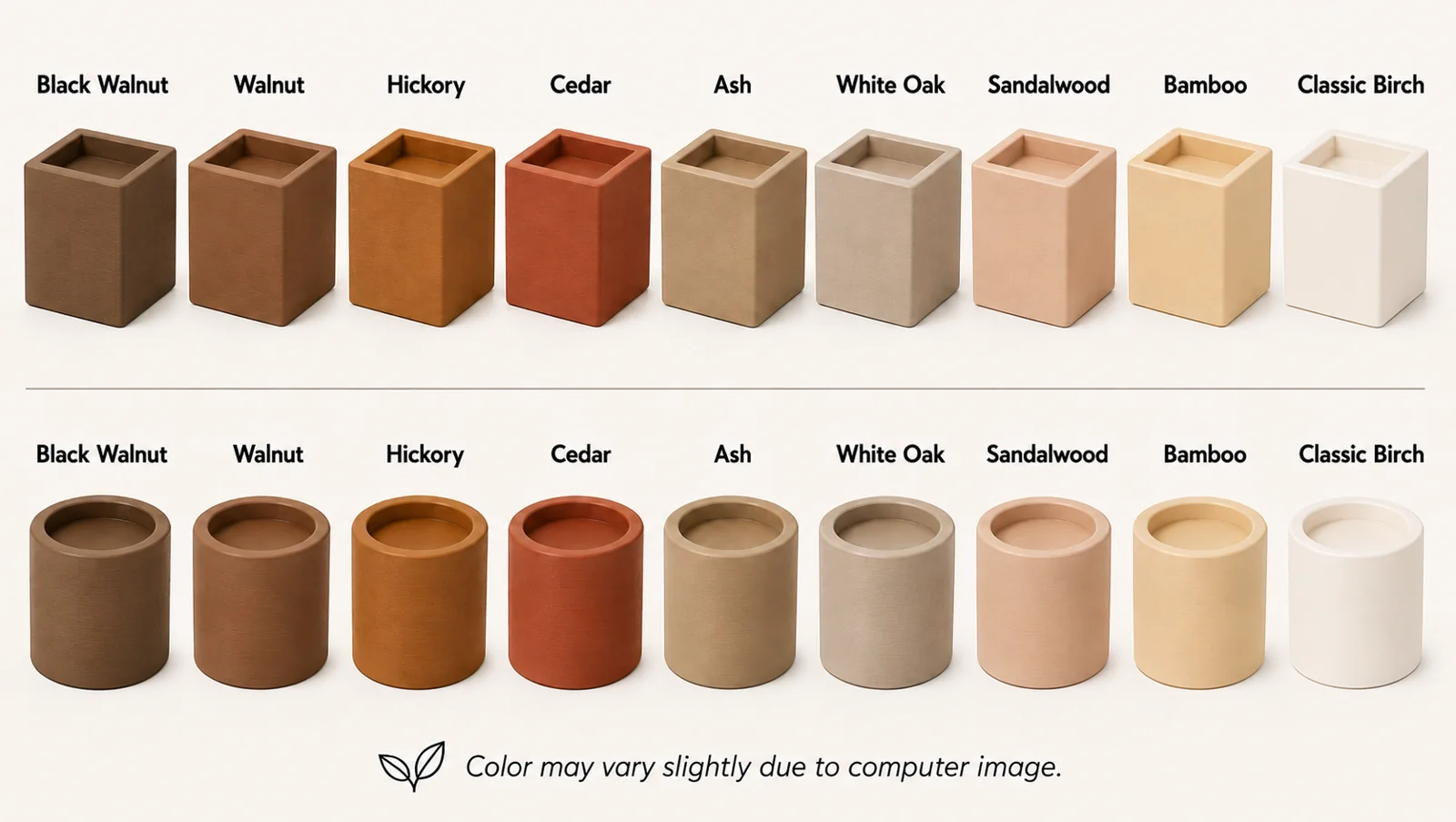

Customize more: wood grain texture, extra stabilityOptional · show
5. Custom shapes & notesOptional · show
Any shape is available: circles, ovals, L-shapes, triangles, tapered or angled legs. Choose the base range that covers the widest part of the leg, then add the shape and its dimensions in the notes below.
0/600 characters
FAQ
Table risers questions
That change is substantially taller than the short adjustments table risers are best suited for, so it is not the normal recommendation. Measure the exact finished height you need and consider a purpose-built table base for a counter-height conversion.