
For sofas and couches
Couch & Sofa Risers, Made for Your Exact Legs
Sofa legs are the least standardized legs in the house. Mid-century sofas taper to a narrow angled tip, chunky sectionals sit on square blocks, and many modern couches hide a short plastic foot under the skirt. Every Riserman couch riser is cut to the measurement you enter, including angled openings for splayed legs.

Cut to your measurement, to two decimal places.
Made to order · ships in 3–5 business days.
Indoor use only, keep out of direct sunlight and extreme temperatures.
Details
Finding and measuring the leg
Start by tipping the sofa back gently against a wall so you can see underneath. Some sofas have four visible legs; sectionals often have six or eight contact points, and a few sit on a continuous plinth with small hidden glides. Count the contact points first, because that is how many risers you need, and they are not always the same size front to back.
Mid-century tapered legs are the tricky case. The tip can be much narrower than the leg is where it meets the frame. Because the leg sits inside the riser, measure the widest part that will be swallowed by the riser wall, usually about an inch up from the tip, and add a quarter inch of clearance. If the leg is splayed rather than vertical, add the shape and the approximate angle in the notes box.
Block legs and plinth glides are simpler: measure the square footprint at floor level, corner to corner across the flat, and add the same quarter inch. Round bun feet get a single diameter measurement used for both width and depth, with a note asking for a round opening.
Why people raise a couch
The most common reason is standing up. Most sofa seats sit lower than a dining chair, and a couple of inches of lift brings the seat up to roughly chair height, which changes how much effort it takes to stand without making the couch feel perched. Measure your seat height now, compare it to a dining chair you find easy to get out of, and use the difference as your lift.
The second reason is cleaning and airflow. Robot vacuums need a few inches of clearance to pass under furniture, and many low sofas do not give it. Measure the gap under the lowest part of the frame, check the height of your vacuum, and lift by the shortfall plus a little margin. A permanently dusty dead zone turns into swept floor.
The third is proportion. A low couch next to a tall window or under a high ceiling can read as sunken, and a short lift with a matching wood tone or metallic finish can make the piece look intentional rather than low. Start with the least height that solves the problem, since a lower seat change preserves more of the couch's original feel and stance.
Weight, seating loads and stability
Sofas apply load unevenly and in bursts. Each person adds their weight to whichever corner they land on. People also sit down hard, lean on arms, and children treat the arm as a seat, all of which put a sudden, off-center load through one or two risers rather than four.
For that reason a modest lift on the widest base your legs allow is the steadiest combination for a sofa, and the reinforced build is worth adding if the sofa is heavy, is a sleeper, or is the main seat in a busy room. Enter the total loaded weight including people in the configurator's weight field. Never sit on the arm of a raised sofa, and never let anyone rock or tip it while it is on risers.
Configurator
Build your couch risers
We've prefilled a typical size for this kind of furniture, change it to your own measurements, then enter the total weight the risers will carry.
1. Base size
Riser footprint, after clearanceChoose the one-inch range your riser should be, after adding clearance to the leg. If your leg is 1" × 1", pick a base range that includes at least 1.25" × 1.25".
2. Height
How far you're liftingChoose the one-inch range for the lift you want.
With a 2–3" base, heights above 7" are grayed out. A narrow footprint lifted that high gets tip-prone, step up a base size to unlock taller risers.
3. Exact dimensions
Dimensions of the riserDecimals welcome, enter your exact number. These are the dimensions of the riser itself, not the furniture leg. If your leg measures 1" × 1", add clearance and enter at least 1.25" × 1.25".
Sizing tip: Add at least 1/4" of clearance on every side of the leg so the riser fits easily and stays stable. A 1" × 1" leg should become a 1.25" × 1.25" (or larger) riser base.
Not sure how to measure? Tap for a quick guide
- Measure the bottom of the leg where it touches the floor, side to side (width) and front to back (depth).
- Add 1/4" to each number for clearance. A 2" leg becomes 2.25".
- For height, pick how much lift you want. Under 3" is the most popular for beds.
- Still unsure? Text a photo of the leg next to a ruler to 860-856-3633 and I'll tell you the size to order.
Starting size, enter your own measurements.
Opening size, including 0.25" clearance
Opening size, including 0.25" clearance
Within 2–3"
Rectangular leg? Choose the range for your longer opening dimension. The shorter side can be below that range, down to 0.5". Add 0.25"to each measured leg dimension before entering it.
Total weight: 200 lbs (typical chair or desk). Heavier? Change this.
Include the furniture plus anything (or anyone) on it, a bed frame, mattress and the people sleeping on it, for example. This helps us build safely.
4. Color
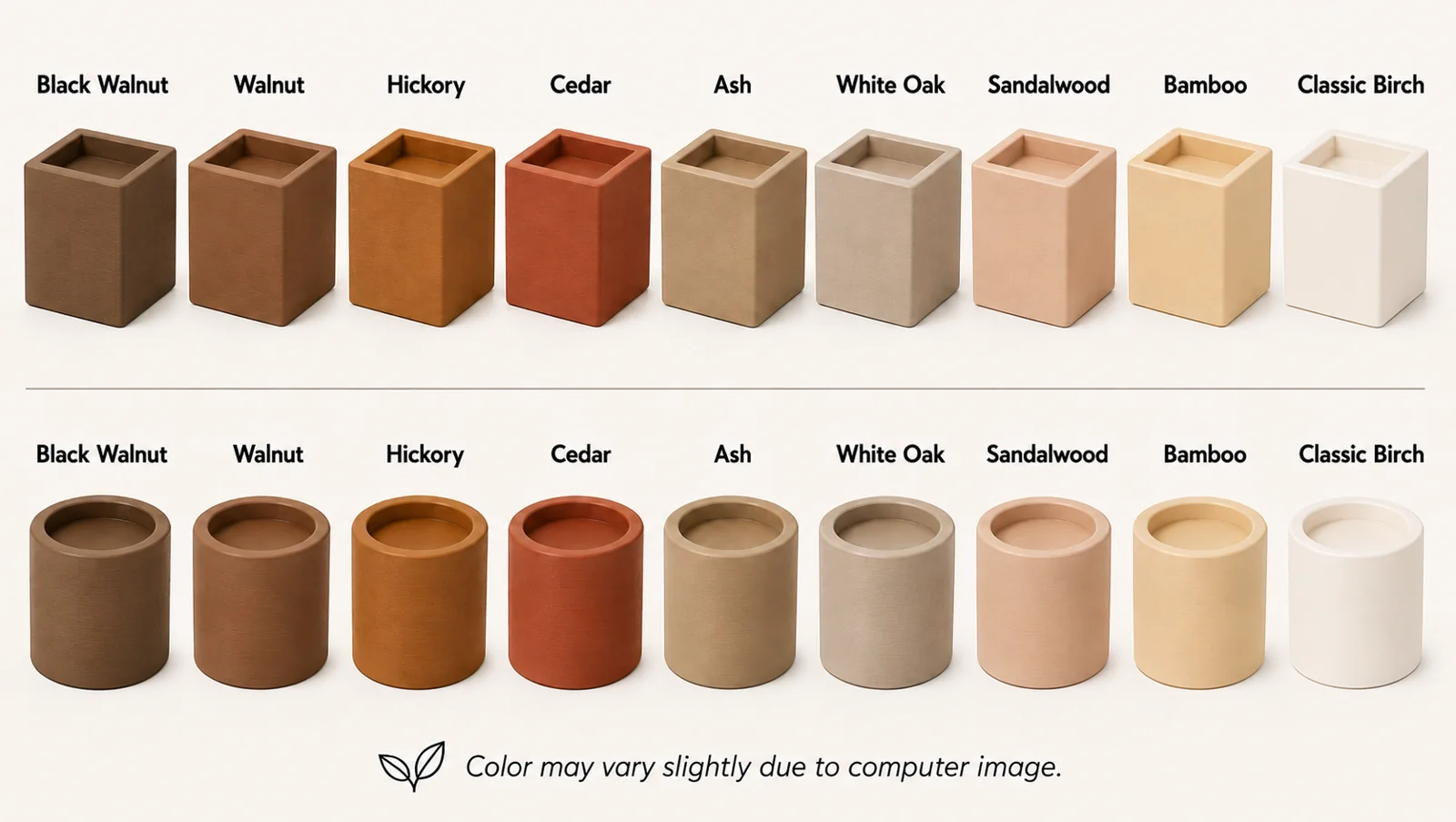
No extra costAll colors are the same price, pick the one that disappears into your furniture.
Wood tones

Customize more: wood grain texture, extra stabilityOptional · show
5. Custom shapes & notesOptional · show
Any shape is available: circles, ovals, L-shapes, triangles, tapered or angled legs. Choose the base range that covers the widest part of the leg, then add the shape and its dimensions in the notes below.
0/600 characters
FAQ
Couch risers questions
One per contact point, and measure each one. Sectionals and sleeper sofas frequently mix a chunky front leg with a small rear glide, so you may need two different sizes. Add each size as its own line in the cart.