
For beds
Custom Bed Risers, Built to Your Bed's Leg Size
Bed frames are the piece people most often want lifted, and they are also the piece most often left wobbling on off-the-shelf plastic risers. A Riserman bed riser is printed after you order, with an opening cut to the measurement you type in, so the leg drops in and stops moving.
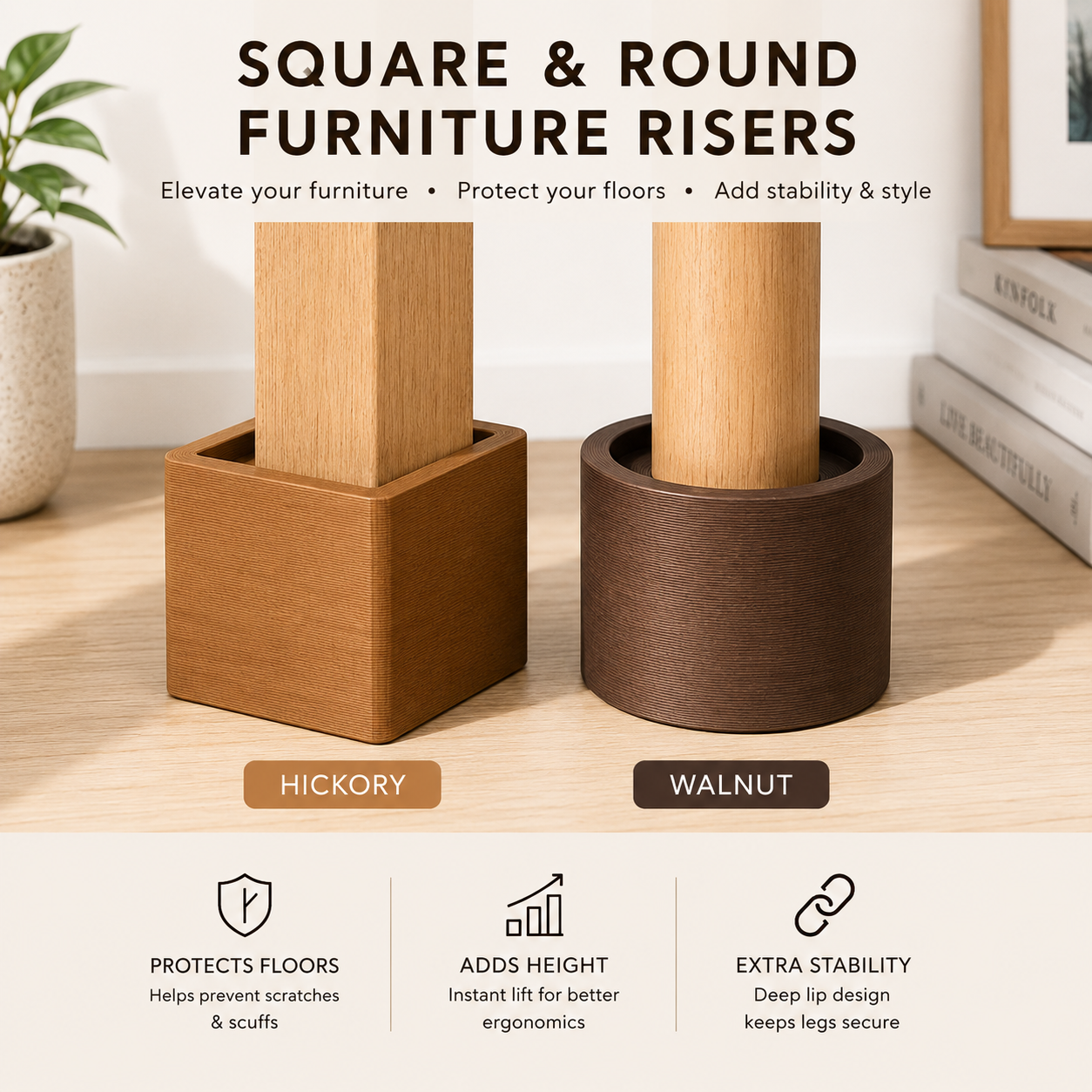
Cut to your measurement, to two decimal places.
Made to order · ships in 3–5 business days.
Indoor use only, keep out of direct sunlight and extreme temperatures.
Details
How to measure a bed leg
Slide the bed away from the wall and look at what is actually touching the floor. Platform beds and Scandinavian frames usually sit on a square or tapered post. Metal bed frames often end in a flat glide plate or in a caster wheel. Antique wooden frames can have turned bun feet that bulge wider partway up. Identify which of those you have before you reach for the tape measure, because each one is measured at a different point.
Measure the widest part of whatever sits inside the riser, not the tip. For tapered posts, measure about half an inch up from the floor, because that is roughly how deep the leg will sit in the riser wall. Then add a quarter inch of clearance to both the width and the depth so the leg seats instead of jamming. Measure all four corners: bed frames get dragged, and a leg that has been knocked out of square will read differently from its neighbor.
If your bed rolls on casters, you have two choices. Either remove the caster and measure the bare post, which gives the steadiest result, or keep the caster and measure the wheel housing at its widest so the whole assembly nests inside the riser. Add any details about the leg shape in the notes box.
How much lift people actually want
For beds, lifts under 3 inches are the typical and recommended choice. This is often enough to clear a vacuum head, fit flat under-bed drawers, and add usable clearance without changing how the bed feels to get into and out of. Measure the tallest thing you want to slide underneath, add working room, and use the difference between that total and your current clearance as the lift you need. Taller lifts remain available in the configurator, but a wider base with a shorter lift is the steadier combination.
Height changes the feel of the bed more than people expect, so check the mattress top height you will end up with before ordering: current mattress top plus the lift equals the finished height.
Because a bed carries a shifting load as people sit on the edge or roll to one side, base size matters more than it does on a static piece. Wider is steadier. If your leg allows it, choose a base range one step wider than the leg needs and note the exact opening in the comment box.
Weight and load on four corners
A bed's weight is not shared evenly. The mattress, the frame and the people on it are nominally divided by four legs, but the moment someone sits on the edge, two corners take most of it. If the frame has a center support foot, that foot needs a riser too or the slats will flex once the corners go up.
Add the reinforced build if the bed is heavy, if the frame has only four contact points with no center leg, or if the bed sees rough use. Weigh up the whole picture: the frame, the mattress and everyone who sleeps on it. Enter that total in the weight field in the configurator so the number is on the order alongside your dimensions.
Configurator
Build your bed risers
We've prefilled a typical size for this kind of furniture, change it to your own measurements, then enter the total weight the risers will carry.
1. Base size
Riser footprint, after clearanceChoose the one-inch range your riser should be, after adding clearance to the leg. If your leg is 1" × 1", pick a base range that includes at least 1.25" × 1.25".
2. Height
How far you're liftingChoose the one-inch range for the lift you want.
With a 2–3" base, heights above 7" are grayed out. A narrow footprint lifted that high gets tip-prone, step up a base size to unlock taller risers.
3. Exact dimensions
Dimensions of the riserDecimals welcome, enter your exact number. These are the dimensions of the riser itself, not the furniture leg. If your leg measures 1" × 1", add clearance and enter at least 1.25" × 1.25".
Sizing tip: Add at least 1/4" of clearance on every side of the leg so the riser fits easily and stays stable. A 1" × 1" leg should become a 1.25" × 1.25" (or larger) riser base.
Not sure how to measure? Tap for a quick guide
- Measure the bottom of the leg where it touches the floor, side to side (width) and front to back (depth).
- Add 1/4" to each number for clearance. A 2" leg becomes 2.25".
- For height, pick how much lift you want. Under 3" is the most popular for beds.
- Still unsure? Text a photo of the leg next to a ruler to 860-856-3633 and I'll tell you the size to order.
Starting size, enter your own measurements.
Opening size, including 0.25" clearance
Opening size, including 0.25" clearance
Within 2–3"
Rectangular leg? Choose the range for your longer opening dimension. The shorter side can be below that range, down to 0.5". Add 0.25"to each measured leg dimension before entering it.
Total weight: 200 lbs (typical chair or desk). Heavier? Change this.
Include the furniture plus anything (or anyone) on it, a bed frame, mattress and the people sleeping on it, for example. This helps us build safely.
4. Color
No extra costAll colors are the same price, pick the one that disappears into your furniture.
Wood tones
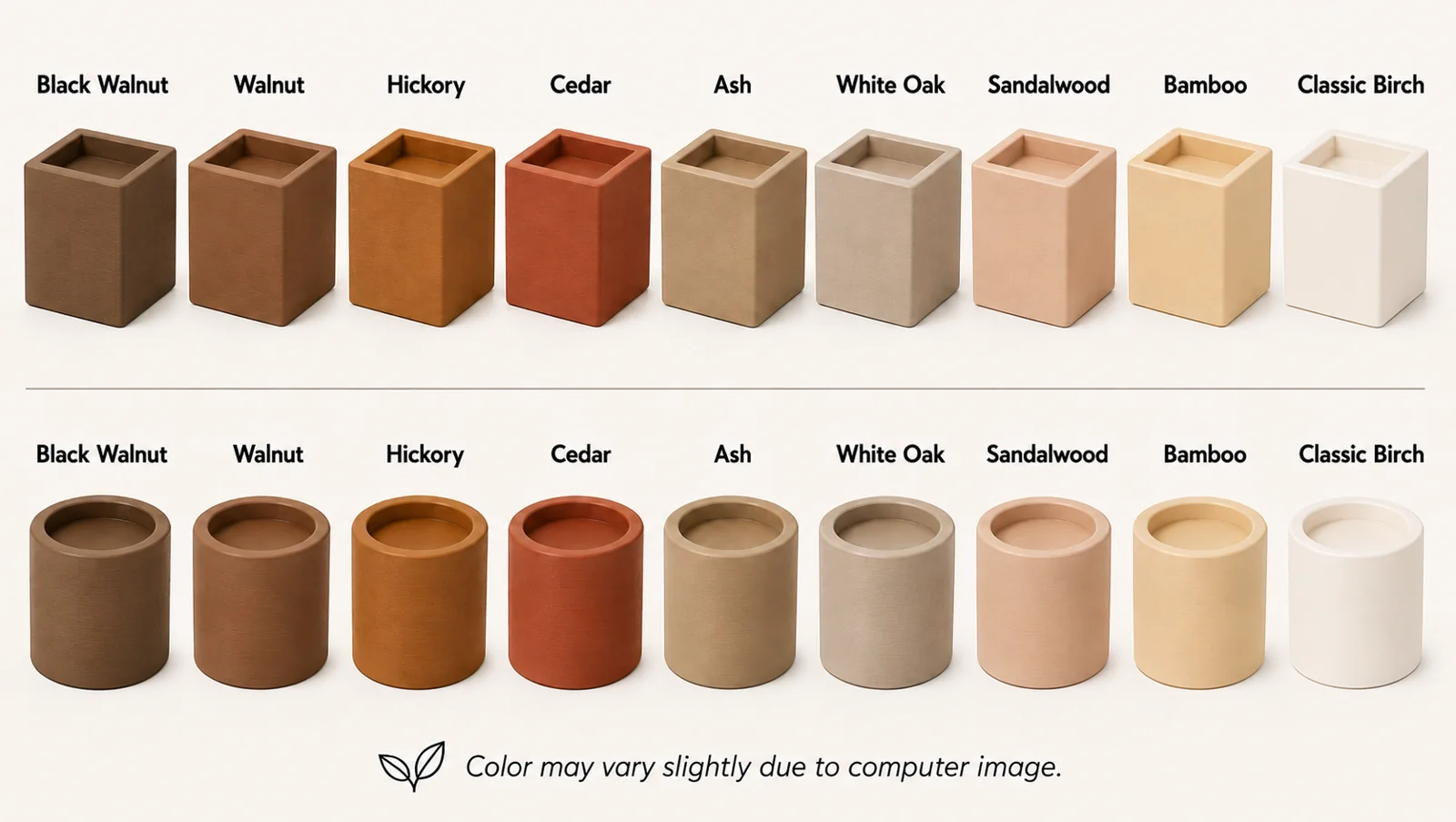

Customize more: wood grain texture, extra stabilityOptional · show
5. Custom shapes & notesOptional · show
Any shape is available: circles, ovals, L-shapes, triangles, tapered or angled legs. Choose the base range that covers the widest part of the leg, then add the shape and its dimensions in the notes below.
0/600 characters
FAQ
Bed risers questions
Yes. Either take the caster off and measure the bare post for the steadiest result, or leave it on and measure the wheel housing at its widest point so the whole caster nests inside the opening. Add which one you did in the notes box.