
Built for weight
Heavy Duty Furniture Risers, Sized to Your Furniture
Beds, sofas, dressers and workbenches put far more load on a riser than a side table does. Every Riserman riser is made to order for your exact leg size, and you can add a reinforced build for extra stability when the furniture is heavy or gets used hard.
Made to order · ships in 3–5 business days.
Reinforced build available on every size and color.
Indoor use only, keep out of direct sunlight and extreme temperatures.
What makes a riser heavy duty
Reinforced build option
Add extra stability at checkout and the riser is printed with denser internal support, so it flexes less under a heavy load. It does not change the footprint, the riser stays the size you entered.
You tell us the load
The configurator asks for the total weight the risers will carry, including people if they'll be sitting or sleeping on the furniture. We use that to sanity-check the size and reinforcement before printing.
Wide bases stay stable
A wider base with a shorter lift is the most stable combination. Tall lifts on small bases are not offered at all, the configurator hides those pairings instead of letting you order something tippy.
Please use caution
Raising furniture changes its center of gravity. Avoid sudden or shifting loads, jumping onto a raised bed, sitting on the arm of a raised sofa, or dragging loaded furniture across the floor. Keep the riser fully under the leg, on a flat, hard, level surface.
Details
What the reinforcement option actually changes
The reinforced build is not a coating and it does not make the riser bigger. Internally, the riser is printed with a much denser support lattice and thicker walls around the load path, so more solid material sits directly under the leg and between the leg and the floor. The result is a part that deflects less under load and resists the slow creep that a lightly built plastic riser shows when it holds weight for months.
It also changes how the riser fails if it is ever overloaded. A standard riser under extreme load will bulge and then split at a wall. A reinforced riser has more material in the way of that crack path, so it deforms further before anything gives, which is what you want under a bed or a loaded shelving unit.
What reinforcement does not do is make a tall riser stable on a narrow leg. Tipping is a geometry problem, not a strength problem, no amount of internal density stops a 2-inch base from being tippy at 8 inches of lift, which is why the configurator hides those combinations regardless of the build you pick.
When a standard riser is enough, and when it isn't
A standard riser is enough for most of the house: side tables, nightstands, plant stands, dressers, desks, single-seat chairs used by an adult of average weight, and any four-legged piece whose load is static and evenly spread. If the lift is modest and nothing moves around on the furniture, the standard build is not the weak link.
Choose reinforced when any one of the following is true: the load is heavy relative to the footprint; the load moves, beds, sofas, sleeper sofas, chairs, anything with people on it; the piece has only four contact points carrying a lot of weight, such as a solid wood wardrobe or a full bookcase; the lift is at or near the maximum offered for your base size; or the furniture gets pushed, leaned on or dragged.
Add it for peace of mind on anything holding people, and specifically on any bed used by two adults. The upcharge is small relative to the furniture it is holding.
How load spreads across four legs
The convenient assumption is that a piece of furniture puts a quarter of its weight on each of four risers. In practice it rarely does. Floors are not perfectly flat, furniture frames flex, and the load itself moves: someone sits on the edge of a bed and two corners take most of the weight; a person leans on the end of a table and one riser briefly carries a large share; a bookcase loaded heavily on one shelf pushes its front pair harder than its back pair.
A sensible way to think about sizing is to assume the two most loaded risers may each carry well over a quarter of the total, rather than splitting it evenly four ways. Wide bases help here as well as with tipping, because a wider footprint spreads the same force over more floor and gives the load somewhere to go when the piece shifts.
Two practical rules that matter more than the arithmetic: every contact point gets a riser, including a bed's center support foot and a sectional's middle glides, and all risers on one piece must be the same height and sit on the same continuous floor surface. A single riser half on a rug edge turns an evenly shared load into a lever.
Configurator
Build your heavy duty riser
Enter your leg dimensions and the total weight the risers will hold, then turn on the reinforced build. Pricing updates as you go.
1. Base size
Riser footprint, after clearanceChoose the one-inch range your riser should be, after adding clearance to the leg. If your leg is 1" × 1", pick a base range that includes at least 1.25" × 1.25".
2. Height
How far you're liftingChoose the one-inch range for the lift you want.
3. Exact dimensions
Dimensions of the riserDecimals welcome, enter your exact number. These are the dimensions of the riser itself, not the furniture leg. If your leg measures 1" × 1", add clearance and enter at least 1.25" × 1.25".
Sizing tip: Add at least 1/4" of clearance on every side of the leg so the riser fits easily and stays stable. A 1" × 1" leg should become a 1.25" × 1.25" (or larger) riser base.
Not sure how to measure? Tap for a quick guide
- Measure the bottom of the leg where it touches the floor, side to side (width) and front to back (depth).
- Add 1/4" to each number for clearance. A 2" leg becomes 2.25".
- For height, pick how much lift you want. Under 3" is the most popular for beds.
- Still unsure? Text a photo of the leg next to a ruler to 860-856-3633 and I'll tell you the size to order.
Select a base range first
Select a base range first
Select a height range first
Include the furniture plus anything (or anyone) on it, a bed frame, mattress and the people sleeping on it, for example. This helps us build safely.
4. Color
No extra costAll colors are the same price, pick the one that disappears into your furniture.
Wood tones
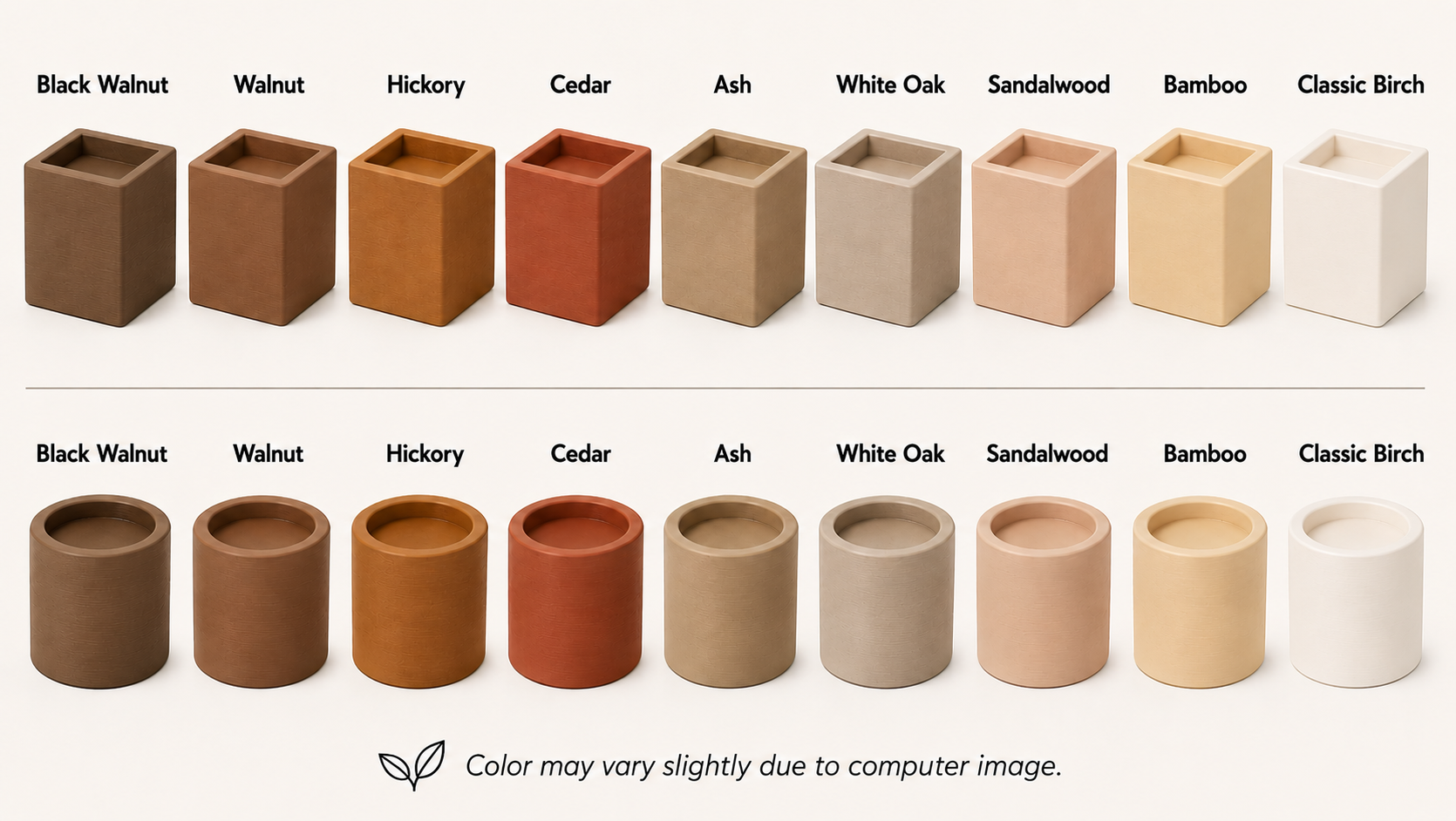
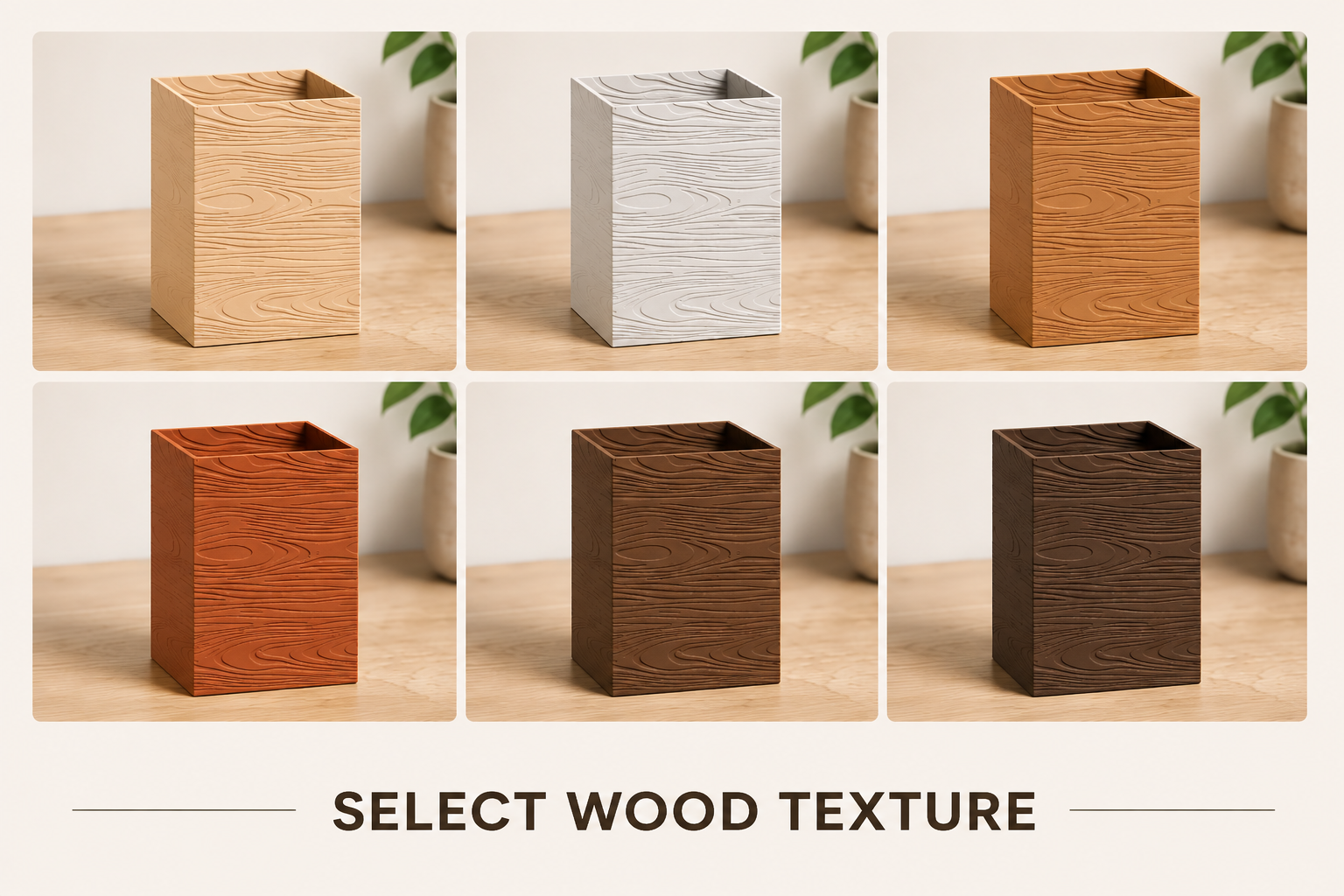
Customize more: wood grain texture, extra stabilityOptional · show
5. Custom shapes & notesOptional · show
Any shape is available: circles, ovals, L-shapes, triangles, tapered or angled legs. Choose the base range that covers the widest part of the leg, then add the shape and its dimensions in the notes below.
0/600 characters
FAQ
Load and strength questions
It depends on the base size and lift, not on the product line. Wider bases and lower lifts carry more comfortably, and the reinforced build raises the practical ceiling on the same footprint. Enter the total weight in the configurator and we use that when reviewing the order.