
For desks
Desk Risers Sized to Your Desk Legs
Most desks are built to a single generic height, and that height only suits people of one size. Rather than buying a new desk or clamping on a converter that raises only the keyboard, risers lift the whole surface to the height your body actually wants, in the finish that matches the room.

Cut to your measurement, to two decimal places.
Made to order · ships in 3–5 business days.
Indoor use only, keep out of direct sunlight and extreme temperatures.
Details
Working out the height you need
Sit in your usual chair with your feet flat and your shoulders relaxed, and have someone measure from the floor to the underside of your forearms with your elbows bent at about ninety degrees. That number is your ideal desk surface height. Subtract your current desk height from it and you have your lift, to the quarter inch.
Take the measurement in the chair you actually use, at the seat height you actually use, because changing the chair changes the answer. A lift of one to three inches is the usual result for someone who finds their desk a little low. Turning a sitting desk into a standing desk is a different problem entirely and needs far more height than a riser under a desk leg should carry. Risers are for fine adjustment and moderate lifts.
Do not forget knee clearance and the keyboard tray. Raising a desk raises its underside too, which is normally welcome, but if you have a drawer pedestal or a tray already scraping your thighs, the lift fixes it; if you have a low bookshelf shoved underneath, check it will still slide out.
Desk leg shapes and how to measure them
Desk legs fall into three families. Square or rectangular wooden posts, common on traditional and farmhouse desks, are the easiest: measure the footprint at floor level and add a quarter inch to each dimension. Flat panel or trestle-style ends, common on flat-pack desks, are wide but thin. A pair of small risers per end, or a long slot opening, suits those better than one square riser. Add the panel's length and thickness in the notes box.
Round steel tube legs, found on most budget and gaming desks, are measured by diameter and need a round opening, which you request in the notes. Many of these desks come with threaded leveling feet screwed into the tube. Measure whichever part will actually sit inside the riser, and if the leveling foot is adjustable, wind it fully in first so all four legs start from the same reference.
Because desks often sit on carpet, check the desk is level after the risers are in. It is much easier to correct a small wobble with the desk's own leveling feet than to reprint a riser.
Weight considerations for a loaded desk
A desk's load is quieter than a bed's or a sofa's but heavier than people guess. Monitors on an arm, a desktop tower, a dock, books and everything else stacked on the surface add up quickly. A monitor arm clamped to one edge matters most, because it puts a constant off-center pull on one corner rather than a share of the load on all four.
The upside is that a desk load is static, so a standard riser with a properly sized opening handles most setups. Add the reinforced build if you lean or sit on the desk edge, if you have a heavy stone or thick butcher-block top, or if the desk is loaded up heavily. Enter the loaded total in the weight field so it is recorded with your dimensions.
Configurator
Build your desk risers
We've prefilled a typical size for this kind of furniture, change it to your own measurements, then enter the total weight the risers will carry.
1. Base size
Riser footprint, after clearanceChoose the one-inch range your riser should be, after adding clearance to the leg. If your leg is 1" × 1", pick a base range that includes at least 1.25" × 1.25".
2. Height
How far you're liftingChoose the one-inch range for the lift you want.
With a 2–3" base, heights above 7" are grayed out. A narrow footprint lifted that high gets tip-prone, step up a base size to unlock taller risers.
3. Exact dimensions
Dimensions of the riserDecimals welcome, enter your exact number. These are the dimensions of the riser itself, not the furniture leg. If your leg measures 1" × 1", add clearance and enter at least 1.25" × 1.25".
Sizing tip: Add at least 1/4" of clearance on every side of the leg so the riser fits easily and stays stable. A 1" × 1" leg should become a 1.25" × 1.25" (or larger) riser base.
Not sure how to measure? Tap for a quick guide
- Measure the bottom of the leg where it touches the floor, side to side (width) and front to back (depth).
- Add 1/4" to each number for clearance. A 2" leg becomes 2.25".
- For height, pick how much lift you want. Under 3" is the most popular for beds.
- Still unsure? Text a photo of the leg next to a ruler to 860-856-3633 and I'll tell you the size to order.
Starting size, enter your own measurements.
Opening size, including 0.25" clearance
Opening size, including 0.25" clearance
Within 2–3"
Rectangular leg? Choose the range for your longer opening dimension. The shorter side can be below that range, down to 0.5". Add 0.25"to each measured leg dimension before entering it.
Total weight: 200 lbs (typical chair or desk). Heavier? Change this.
Include the furniture plus anything (or anyone) on it, a bed frame, mattress and the people sleeping on it, for example. This helps us build safely.
4. Color
No extra costAll colors are the same price, pick the one that disappears into your furniture.
Wood tones
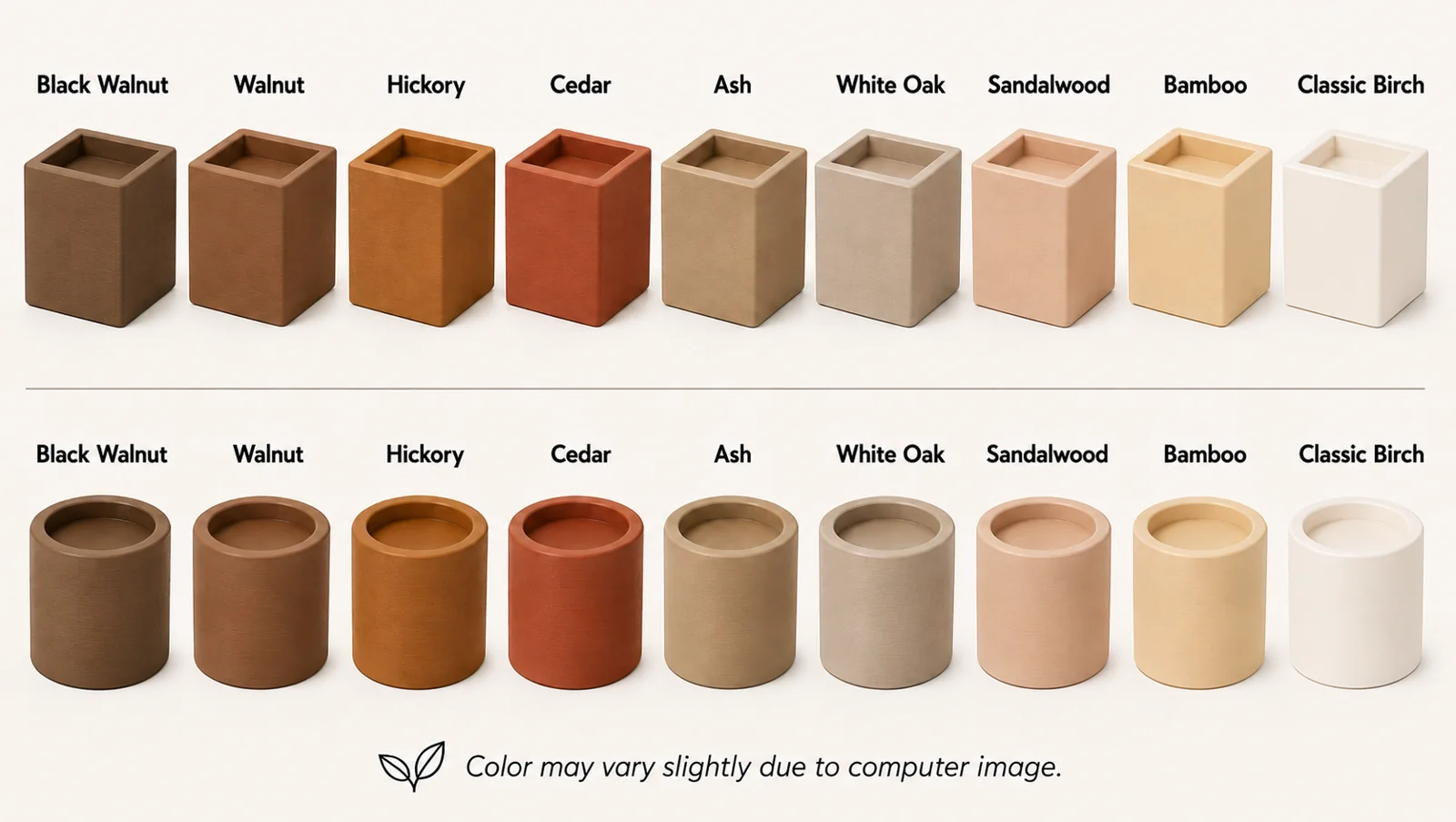

Customize more: wood grain texture, extra stabilityOptional · show
5. Custom shapes & notesOptional · show
Any shape is available: circles, ovals, L-shapes, triangles, tapered or angled legs. Choose the base range that covers the widest part of the leg, then add the shape and its dimensions in the notes below.
0/600 characters
FAQ
Desk risers questions
No. A standing work surface needs far more height than a desk-leg riser is intended to provide. Desk risers are best used for the small adjustment found by measuring your seated elbow height, not for a full sit-to-stand conversion.