
How to Secure Bed Risers on the Floor So They Stay Put
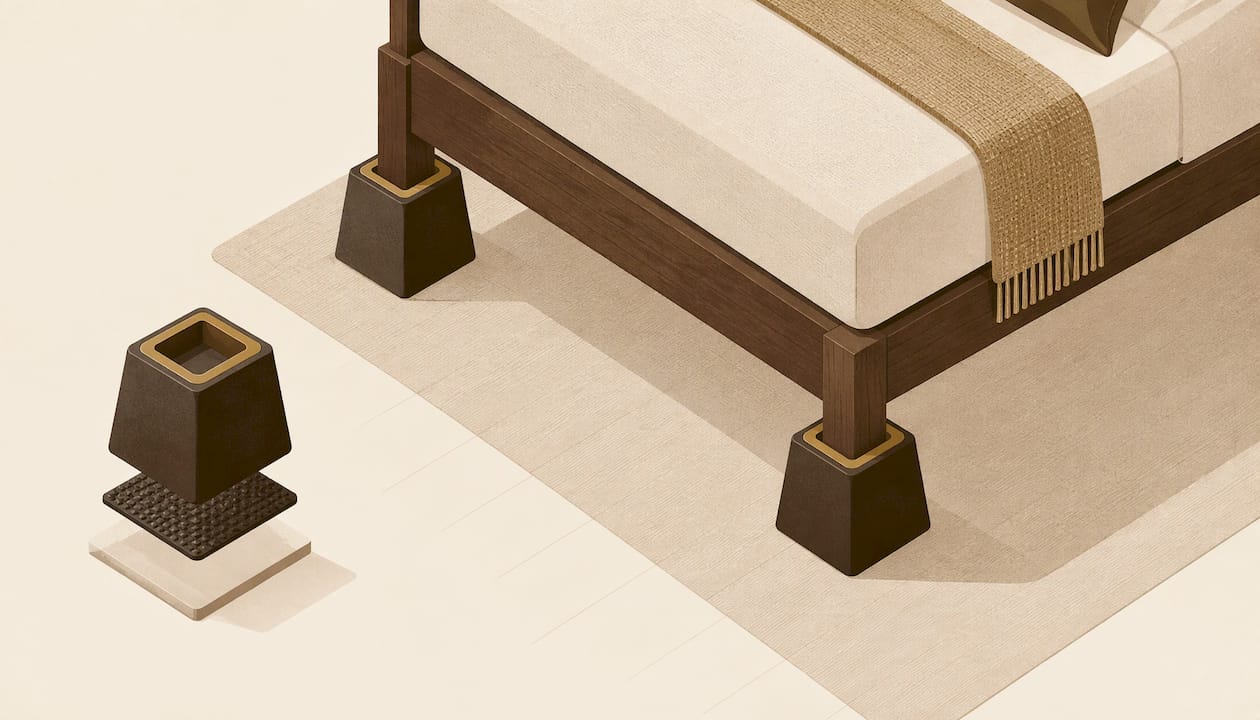
Bed risers stay put when three things line up: the riser fits the leg, the floor contact is level, and the base grips your type of floor. Most slipping and wobbling comes from a loose fit or an uneven floor, not from the risers themselves. That is why we build bed risers sized to your exact leg: a leg that sits snugly in a riser made for it has far less room to shift.
This guide walks you through installing risers safely, stopping them from sliding, fixing a wobble, and handling an uneven floor.
TL;DR
- Measure your bed legs before you buy. A riser that matches the leg shape and size keeps the leg from drifting inside it.
- Use risers under every leg, including center supports, all at the same height.
- Level first, then add grip. A bed that rocks on one leg will keep moving no matter what pads you add.
- Match the grip to the floor: rubber-type grippers on many hard floors, felt on others, a wide base on carpet.
- Press every corner after installing, and recheck after the first week.
Table of Contents
- Why risers slide and wobble
- Before you install: check the frame, the floor and the fit
- Installing risers step by step
- Stop bed risers from slipping
- Stop a bed on risers from wobbling
- Risers for uneven floors
- Weight, strength and keeping risers from cracking
- Made for your legs, not the nearest size
- Our perspective
- FAQ
- Sources
Why risers slide and wobble
A bed frame is heavy, but it is also pushed sideways every time someone sits down, rolls over or gets out of bed. On a smooth floor such as hardwood, tile or laminate, small metal or plastic feet have little to hold on with. Raise the bed and you also raise the point where that sideways push is applied, so any looseness in the setup shows up faster.
Three causes account for nearly every case:
- A loose fit. The leg rattles inside the riser, or rests on the rim instead of seating fully.
- An uneven load. One leg floats or one corner carries more weight, so the frame twists a little each time you move.
- A floor with too little friction or too little flatness. Polished wood and tile are slick. Older floors are rarely perfectly flat.
Wirecutter’s reporting on bed frames, quoting furniture maker Maximilian Hoener, points to uneven weight distribution from an unleveled frame or weak center support as the main force that loosens and warps bed joints over time. So leveling is not only about comfort. It protects the frame.
Before you install: check the frame, the floor and the fit
Spend ten minutes on this and the rest goes smoothly.
Check that your bed is suited to risers
Risers work on frames that stand on four or more stable legs. Hospital guidance from a UK NHS trust is a useful reference on the limits. It says not to use bed raisers on uneven or weak flooring, when legs or castors are missing, or if the bed is likely to move when getting in or out. It also says two people are needed to lift the bed safely during fitting. Those points apply to any home bed: if the floor is soft or damaged, repair it first, and never raise a bed that already shifts under you.
Bunk beds, loft beds, adjustable bases and electric profiling beds are not candidates for risers. If your bed is one of these, check with the manufacturer about taller legs instead.
Check the floor
Press down on the floor where each leg will stand. It should not flex or feel soft. Then lay a straight edge or a level across the area where the bed will sit. If you see a gap, note which side is low. You will deal with that in the leveling step below. If you have hardwood, our guide on protecting hardwood floors when using furniture risers covers the contact surface in more detail.
Measure the legs
Measure each leg where it will sit in the riser: the width and depth for a square leg, the diameter for a round one. Check the center support legs too, because they are often a different size from the corner legs. Also note any angled or tapered legs, since a flat cup will not hold a slanted foot properly.
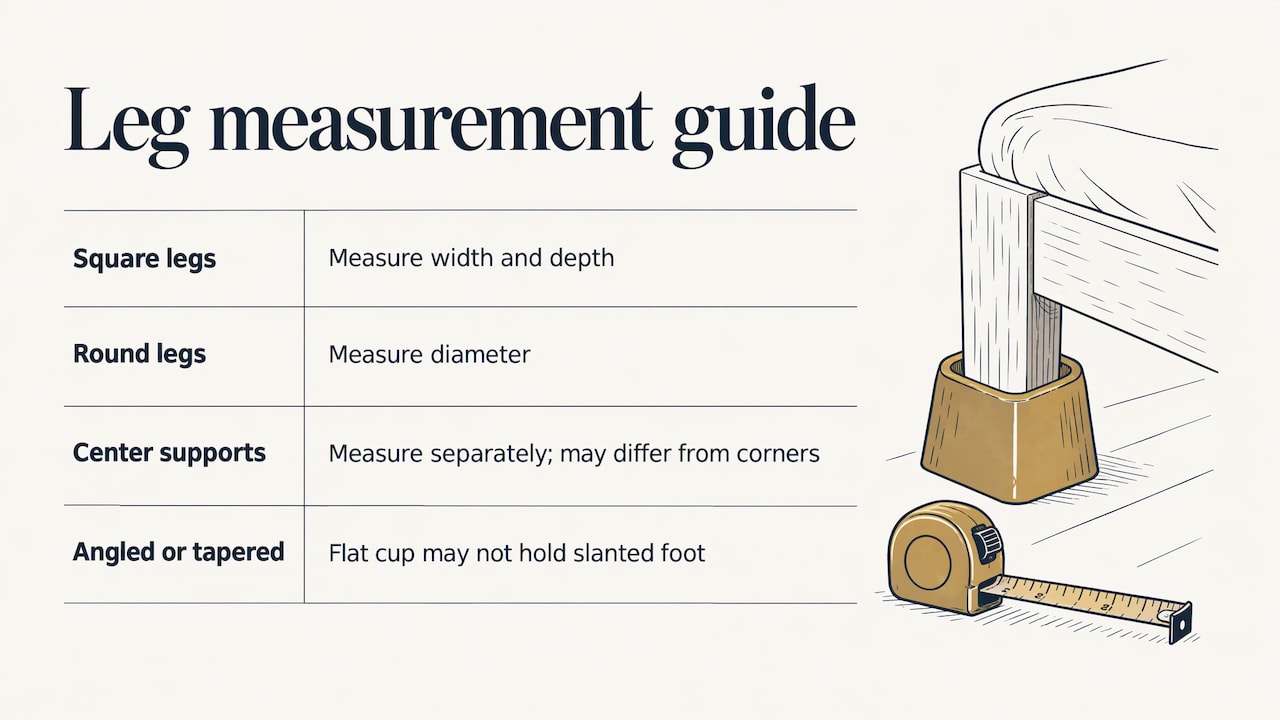
This is where standard risers cause trouble. They come in preset sizes, so a leg that is a little smaller than the opening sits loose, and a leg that is irregular does not seat at all. Our configurator accepts measurements down to the hundredth of an inch and supports round, angled, irregular and standard legs, so you enter what you measured rather than choosing the nearest size.
Decide the height
Pick the lift you need and stick to one height for all legs. If you are raising the bed mainly for storage, how much lift you really need under the bed is worth a look before you order. For a broader comparison of ways to gain height, see how to raise bed height.
Installing risers step by step
- Clear the bed. Remove the mattress and bedding so the frame is as light as possible.
- Get a second person. One person lifts a corner or end of the frame while the other sets the risers. Lifting a loaded frame alone is how backs and floors get hurt.
- Place a riser under every leg. Include the center supports. Using risers at only some legs creates a frame that rocks.
- Seat each leg fully. The leg should rest completely inside the riser, not balanced on an edge. Look at each one from the side before you lower the frame.
- Lower the frame slowly. Keep fingers clear and check that no riser tipped as the weight came down.
- Push down on each corner. Nothing should rock, tilt or click. If it does, lift that corner again and reseat the leg.
- Put the mattress back and test. Sit on different edges of the bed, then lie down and roll over. A secure setup feels the same as before, only higher.
- Recheck after about a week. Risers can settle slightly, especially on carpet, and any movement shows up in this window.
If a leg ever feels loose in its riser at step 4, that is a sizing problem, and the answer is a riser made for that leg rather than padding that leg with tape or cardboard.
Stop bed risers from slipping
Sliding is a floor problem more than a riser problem, so choose the fix for your surface. Fix the level first (see the next section), then add grip.
Hardwood, laminate and tile
These surfaces are slick. Rubber-type gripper cups or non-slip bases under the risers add friction. WIRED’s bed frame repair guide quotes an expert recommending rubber gripper cups on bed frame feet, noting that loose felt pads can move around while cups hold the foot and spread the weight to protect the floor.
A few practical points:
- On tile, shift the bed an inch or two if a leg sits half in a grout line, so each leg rests on a flat tile face.
- Some rubber can stain certain floors, especially light wood and vinyl. Try a small piece in a closet corner for a couple of days before you commit, or ask your floor’s manufacturer what it recommends.
- Avoid strong adhesives on finished wood, which can discolor it.
We cover the floor-contact side in more depth in our article on protecting hardwood floors.
Carpet
On carpet, the risk is less sliding and more sinking and creeping. A wide, flat base spreads the load so the riser does not dig into the pile. Press each corner again after a week, because carpet compresses under load and a riser that was level on day one can lean by day seven.
A simple way to find the real cause
Place painter’s tape beside each leg, then sleep on the bed for a couple of nights. If every leg moved the same distance in the same direction, friction at the floor is the issue. If one end moved much more than the other, look at leveling or at how the headboard is attached.
Common mistakes
- Grip on only some legs. Uneven friction makes a bed pivot around the grippiest corner. Treat all legs the same.
- Folded paper or cardboard as a shim. It compresses, and the wobble returns.
- Stacking risers to gain height. A single piece made to your height is more stable than a stack. We build to the height you specify, so you do not need to stack.
Stop a bed on risers from wobbling
A wobble means one leg is not carrying its share. Find it, then fix the cause.
- Find the light leg. Press down on each corner and the middle of each side. The corner that lifts or the one diagonal from the one that drops is your suspect.
- Check hardware. Tighten every bolt and bracket on the frame itself. Hardware on a bed shifts over time, and Wirecutter’s reporting notes that beds are built to come apart for stairs and doorways, so bolts and joints loosen with use.
- Check the center leg. The same reporting says a center support is often set too long. It should just skim the floor, so the weight of the mattress brings it into full contact. Too short gives no support, and too long lifts the frame and creates a see-saw.
- Level the frame. Place a level along each side rail and across the head and foot. Wirecutter’s experts suggest confirming all four corners are flush with a level and using wood shims where the feet are not adjustable.
- Shim the low spot, not the whole bed. A hard, thin shim under the low leg or riser corrects a small gap. A shim should be a solid material such as wood or hard plastic.
- Retest. Press each corner again and sit on the edges.
If you find that different legs on your bed sit at different heights to begin with, our guide to diagnosing and fixing uneven furniture legs explains how to measure the difference. Because we make each riser to your dimensions, you can specify a slightly different height for a leg that is shorter, instead of shimming it later.
Risers for uneven floors
A slightly uneven floor can be managed. A badly uneven or weak floor cannot, and the NHS guidance above is clear that bed raisers should not be used there.
For a modest gap:
- Level the frame with a shim under the low point before adding any grip.
- Do not fix it by unscrewing a leg. Tempur-Pedic’s owner’s manual for its Tempur Up base says to hand-tighten legs securely without over-tightening and says not to unscrew a leg to compensate for an uneven floor, because a partly threaded leg may become unsafe.
- Recheck after the first night. If one corner shifts, lower the bed and correct the fit instead of waiting for it to settle.
If the floor is clearly sloped, soft or damaged, repair the floor or move the bed to a flat area before raising it.
Weight, strength and keeping risers from cracking
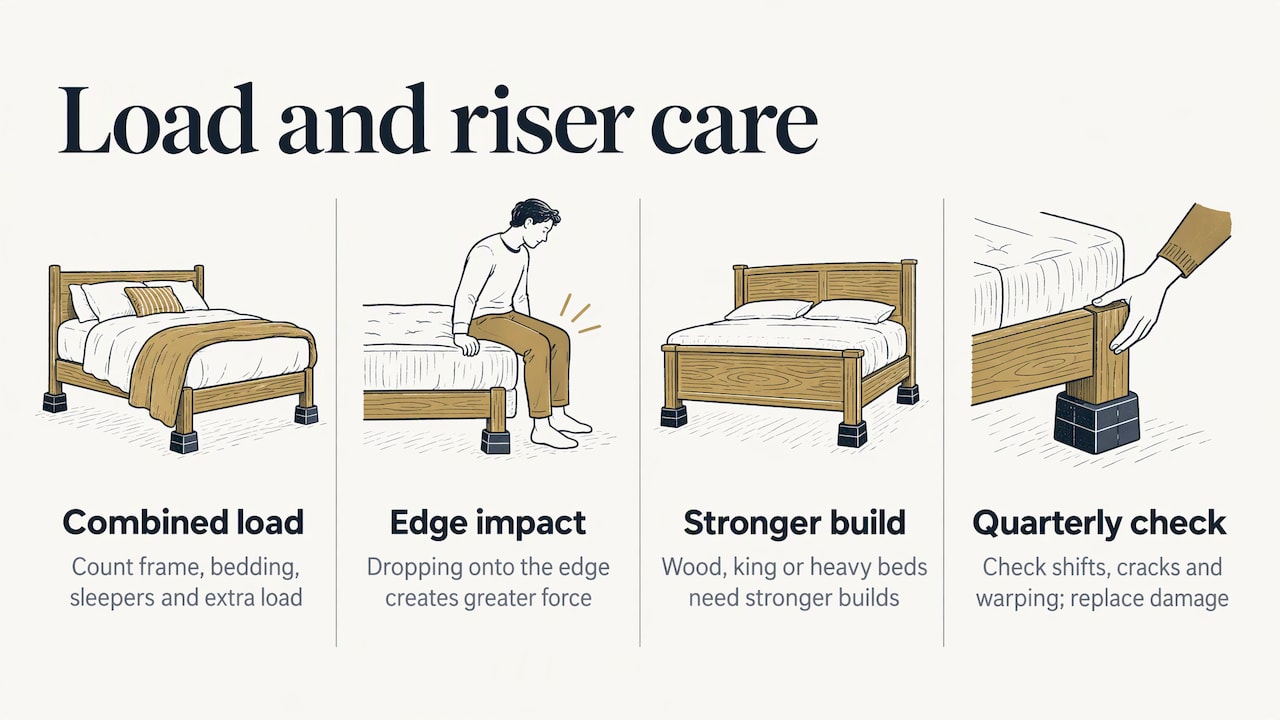
A bed carries more than the mattress. Add the frame, the bedding, the people, and the extra load when someone sits down hard on the edge. That last part matters because the force of dropping onto a mattress edge is higher than the same weight resting still.
For most households the sensible approach is to choose risers with plenty of margin over the combined load of the bed and its sleepers, and to choose a stronger build for a solid-wood frame, a king-size bed or a heavy mattress. We make heavy duty furniture risers to order, and the configurator has an extra stability option at $5.00 one-off per riser for heavier uses. If you want to know more about the material side, read our guide on how to prevent bed risers from cracking.
Once a quarter, press each corner, look for risers that have shifted, and check for any visible cracks or warping. Replace anything that looks damaged.
Made for your legs, not the nearest size
Most of the work above exists to compensate for a riser that does not quite fit the leg. A riser built to your measurements removes the biggest source of movement before you start.
Here is what you get with RiserMan:
- Risers sized to your leg measurements, down to the hundredth of an inch, for round, angled, irregular or standard legs.
- A configurator that updates the cost as you choose options, so you see the total before checkout.
- Options for wood tones, solid colors and metallic finishes, plus wood grain texture at $5.00 one-off per riser and extra stability at $5.00 one-off per riser.
- Hidden storage enhancements for the space under your bed.
Start on our bed risers page, enter your leg measurements and pick your height.

If you are also raising a sofa, desk or chair, the same approach applies: see couch and sofa risers and desk risers.
Our perspective
Most bed riser problems we hear about are fit problems in disguise. A leg that is a few hundredths of an inch off, or a foot with a slight angle, will move inside a preset opening, and every fix after that is a workaround. We think the better route is to start from the leg itself.
That is why our configurator asks for your measurements instead of offering a few sizes. Round legs, angled legs and irregular legs all get a riser made for them, and you see the price change as you choose height, finish and stability options.
Secure risers are not complicated: a snug fit, equal height under every leg, a level frame and a grip that suits your floor. Do those four things and a raised bed feels like it was always that tall.
Harris
FAQ
Can I put bed risers on carpet?
Yes, with care. Carpet compresses under load, so a riser can settle or lean over the first week. Use a wide, flat base that spreads the weight, push on every corner after installing, and recheck after a week.
Do I need risers under the center legs?
Yes, if your bed has center support legs, they need the same height as the corner legs. A center leg that is too short gives no support and one that is too long lifts the frame and causes a see-saw, according to Wirecutter’s expert advice on the center leg skimming the floor.
Is it safe to use cardboard or folded paper to stop a wobble?
No. Cardboard and paper compress with weight, so the wobble comes back. Use a hard shim, such as thin wood or hard plastic, under the low point, and retest by pressing each corner.
What if my bed legs are round or angled?
A riser made for that shape will hold it better than a flat cup. We make risers for round, angled and irregular legs to the measurements you enter, so the leg seats fully instead of balancing on an edge.
How often should I check my risers?
Check after the first night, again after about a week, and then every few months. Press each corner, look for any riser that moved, and replace any that show cracks or warping.
Sources
- Bed raisers, Kingston and Richmond NHS Foundation Trust
- How to Fix a Squeaky Bed Frame, Wirecutter
- How to Fix Your Bed Frame: Squeaking, Slipping, and More, WIRED
- Tempur Up Complete Reference Guide, Tempur-Pedic